When minerals are rarer than diamonds
Contrary to popular belief, diamonds are not a rare mineral. Truly rare are species that form only under extremely specific conditions: some are known to exist in fewer than a handful of specimens worldwide and are found almost exclusively in museums and research collections. They play virtually no role in the collectors' market – they are simply unobtainable.
What remains accessible for collectors
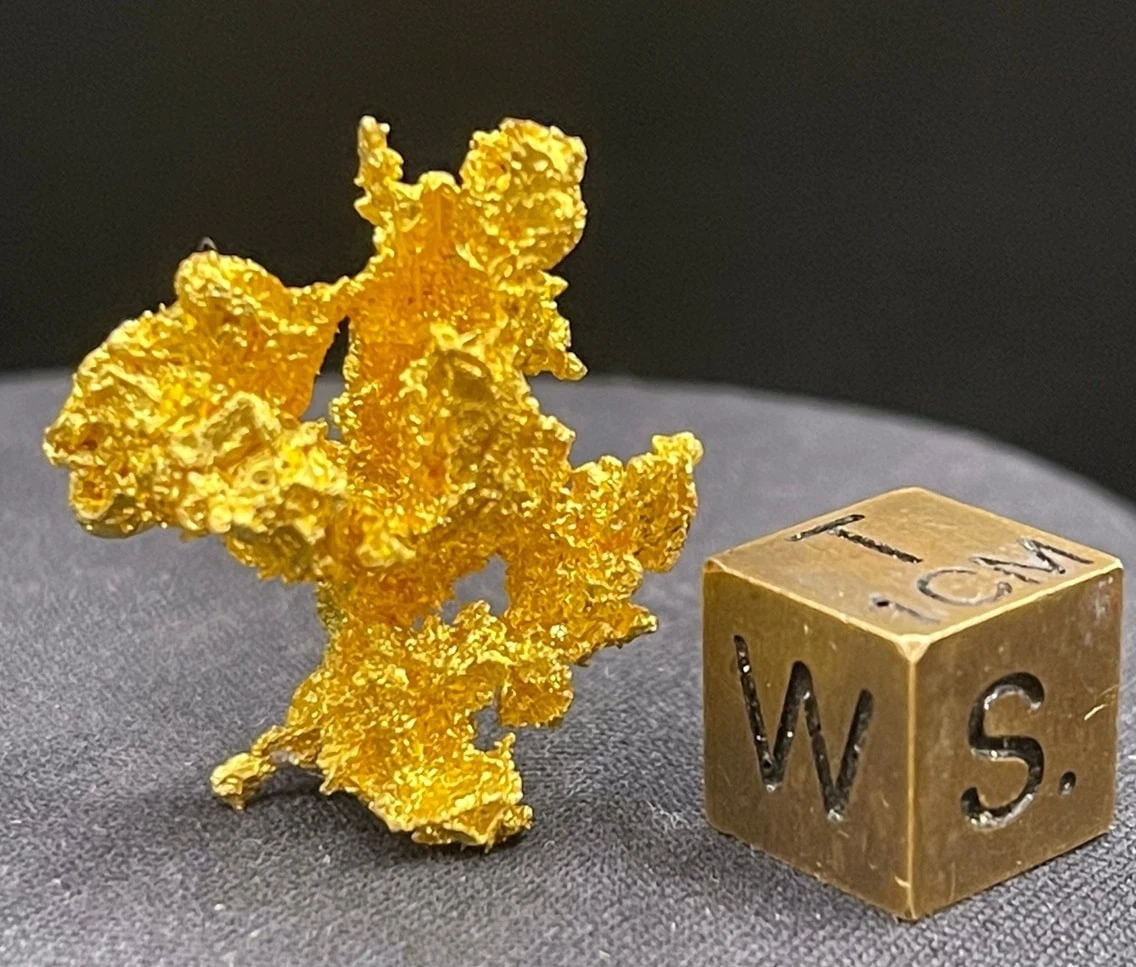
More interesting is the category below: minerals and formations that are rare enough to be sought after, but still tradable. Naturally crystallized gold belongs to this category, as do world-class vanadinite from Mibladen or complete Ordovician crinoid colonies . Here, quality determines rarity – not the chemical formula.
Correctly classifying rarity
When considering offers for "extremely rare" items, always ask for the reason: Is it a rare species? Is the locality exhausted? Is it of exceptional quality? And have the provenance documented. The article "Rare Items" under Minerals explains how rarity generally arises .
Examples of extreme rarity
The scientific community maintains entire lists of minerals that exist worldwide only in milligram quantities – often from a single locality, some as microscopic grains in a single specimen. Such species are scientific treasures, but practically never appear on the market. More readily attainable are "classic" collector's rarities: rare color variations of known species, extinct deposits with limited original stocks – or natural phenomena such as well-crystallized gold , which, despite being an everyday metal, is among the rarest collector's items of all.
In practical terms, this means: Don't focus on the unattainable superlatives, but on the achievable peak – that's where true collection quality is created.
Rarity and price: no automatic equation
It's important to understand that rarity doesn't automatically mean expensive – demand is also crucial . An unassuming mineral collected by only three specialists remains affordable; an aesthetically pleasing specimen of a "merely" unusual species can fetch top prices. The collectors' market values the combination of rarity, beauty, and history. How to acquire such pieces safely is explained in the article " Buying Rare Minerals" ; the underlying system is explained in the section "Rare Minerals" .
From our Moroccan focus, we can offer one thing above all: the rare pinnacle of what is achievable – world-class vanadium, exceptional crinoid slabs, and crystallized natural gold . Inquire about our current unique pieces.
Frequently asked questions about the rarest minerals
Is it even possible to buy the rarest minerals in the world?
The extreme cases – species with only a handful of specimens worldwide – are practically unavailable: they reside in museums and research institutions. Only the very best specimens are for sale: rare specimens, extinct fossil sites, exceptional qualities. In these cases, your network matters more than your budget.
Why are diamonds not rare minerals?
Because tons of diamonds are mined worldwide every year – their market prices are determined by demand and controlled marketing, not by mineralogical rarity. Many inconspicuous collector minerals are objectively thousands of times rarer than gem-quality diamonds.
What rare pieces are available from Morocco?
Above all, we focus on three categories: top-grade, large-crystalline, flawless vanadinite; naturally crystallized gold on quartz; and complete, museum-quality Moroccan crinoid colony slabs. We source all three directly from the source with documented provenance.
The most important points in brief
- Extreme rarity (single-find species) is not for sale – the relevant factor is the achievable peak price .
- Rare + beautiful + in demand = valuable; rarity alone is not enough.
- Even everyday items like gold become true rarities in crystal form.
- Access to rare pieces is achieved through proximity to sources and stored wish lists.
Practical tip from M-Mineralien: Instead of chasing after the "rarest" names, define your personal niche of rarity – for example, "vanadinite crystals over 2 cm, undamaged." Such precise goals are achievable, retain their value, and make your collection something that no catalog in the world can replicate.
Finally, a reassuring point: You don't need to own the world's rarest minerals to have a significant collection. Meaning arises from coherence – a clear idea, consistently implemented. A complete suite of top-quality Moroccan classics is "rarest" than most individual rarities because hardly anyone has the patience for them. You can create rarity yourself: through a discerning selection process that no one else possesses. This is the most democratic form of rarity – and the only one that doesn't depend on chance.
The dynamic nature of the rarity is also interesting to consider: the list of the rarest minerals is not static. New analytical methods discover new species every year, while subsequent discoveries suddenly put some "unique" specimens into perspective. For collectors, this means that today's superlatives of rarity can be obsolete tomorrow – all the more reason not to chase names, but rather quality and documentation. These retain their value, regardless of what science discovers or reclassifies next. Ultimately, only one thing remains consistently rare: the truly perfect specimen of its kind.