
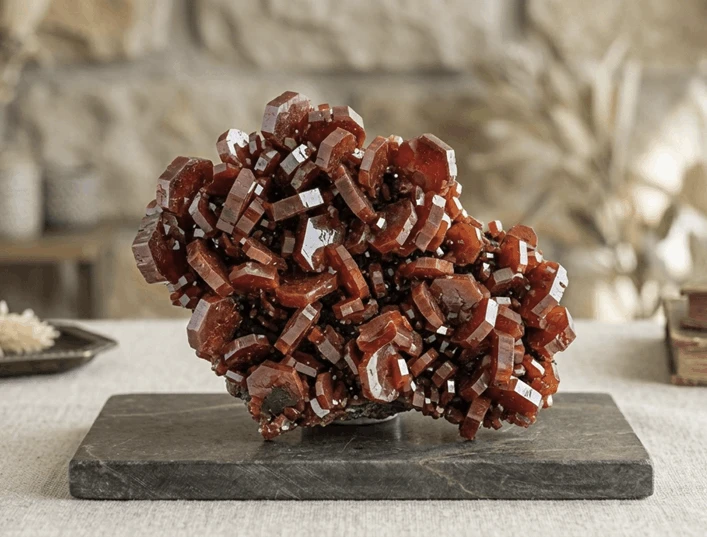
The most common manipulations
At the top of the list: dyed stones (brightly colored agates, “rainbow” quartz), synthetic crystals sold as natural specimens, glued compositions (foreign crystals on foreign matrix), artificially vapor-coated surfaces (“Aqua Aura”) – and, in the case of fossils, recarved details up to completely cast trilobites.
Warning signs you should take seriously
Too perfect symmetry, unnaturally bright colors, traces of glue on crystal bases, a conspicuously smooth "matrix," prices far below market level, and suppliers who don't provide detailed photos or evade questions. A simple test if color is suspected: pigment often visibly collects in the depressions of dyed pieces.
The best protection: the right source.
Ultimately, the only way to protect yourself against professional forgeries is to buy from dealers who know their supply chain and stand behind their products with their name. We personally examine every piece, know our preparators personally, and openly disclose every restoration – you can read about it in our promise on the " Buy Fossils" page . When in doubt, it's always better to ask more questions. Reputable sellers appreciate discerning customers.
Testing methods for home use
Much can be discerned with simple means: Under a 10x magnifying glass, adhesive residue (glassy edges on crystal bases), color pigment in depressions, and casting seams on "fossils" become apparent. The UV test (an inexpensive 365 nm lamp) reveals many adhesives and synthetic resins as brightly fluorescent areas. A cotton swab dipped in nail polish remover applied to an inconspicuous area shows whether the color comes off—nothing happens with natural paint. And the weight test : Synthetic resin feels suspiciously light and "warm" for its size, while stone feels cool and heavy.
Important: These tests provide indications, not definitive judgments. If in doubt, the professional community – stock exchanges, associations, experienced traders – can usually help quickly and free of charge.
How to avoid counterfeit goods when buying online
Online, a simple checklist offers protection: request multiple photos including the back, ask for measurements instead of macro illusions, specify the exact location where the specimen was found, ask questions and pay attention to precise answers – and be generally skeptical of mass offers of new, "rare" mineral specimens ("100 pieces available!"). Unique specimens don't come in packs of a hundred.
The most sustainable protection remains the source: Retailers who know their supply chain personally simply don't stock counterfeit goods. You can read about how we ensure this under About Us – and if you have a specific suspicion about one of your items, simply send us photos for an honest second opinion.
Frequently asked questions about counterfeits
Which minerals are most frequently counterfeited?
At the forefront: citrine (usually heat-treated amethyst), turquoise (often dyed howlite or plastic), "rainbow" agates (dyed), moldavite (glass imitations), and, among fossils, especially Moroccan trilobites (cast replicas). Skepticism is also warranted with intensely colored, cheap crystals from mass-market suppliers.
What should I do if I've bought a counterfeit?
Document the condition with photos, calmly confront the seller with the evidence, and demand a refund – in cases of deliberate deception, you generally have a legal right to a refund. Platform purchases can usually be reversed through buyer protection. And: Leave a review so others are warned.
Does M-Mineralien also test samples purchased from other sources?
Yes – send us clear photos (full view, details, back), and you'll receive an honest, free second opinion on authenticity and market value. In tricky cases, we'll also be upfront about when only a complete examination can provide certainty.
The most important points in brief
- The most common tricks: dyeing, burning, gluing, pouring – and enhanced photos.
- A magnifying glass, a UV lamp, and common sense will expose most of the manipulations.
- Unique items don't come in packs of a hundred: mass offers of "rare" pieces are a warning sign.
- The best protection is the source – retailers with a personally verified supply chain.
Practical tip from M-Mineralien: Build up a small reference collection of genuine specimens – one confirmed authentic example of each species you collect. Nothing trains your eye better than direct comparison in your own hand when a suspicious offer comes along.
Finally, perhaps the most reassuring truth: with every piece you examine, you'll improve. Forgery detection isn't a talent, but experience – and that accumulates surprisingly quickly if you consciously inspect every new acquisition under a magnifying glass and UV light, even those that are undoubtedly genuine. This way, your eye learns to recognize what's normal, and anything amiss becomes obvious. Combined with healthy skepticism when it comes to bargains and using the right source, you'll be better protected than many a long-time collector who has never systematically examined items.