Quality always beats quantity.
The most valuable collections we've ever acquired were rarely the largest. They were the curated ones: a few, but excellent mineral specimens – sharp crystals, undamaged edges, harmonious aesthetics. A guiding principle: one outstanding piece is more valuable than ten mediocre ones. Those who concentrate their budget on fewer, but better pieces, build a stronger collection in the long run.
Provenance: the second half of the value
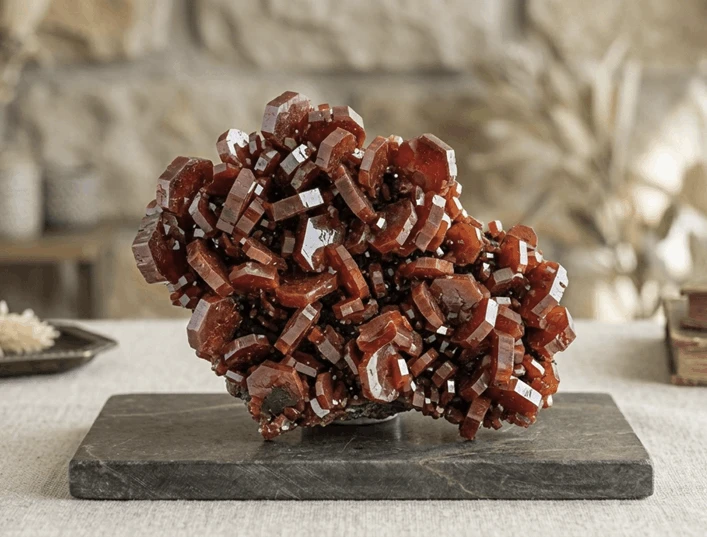
The provenance is part of a mineral's identity. "Vanadinite, Mibladen, Morocco, 2026" is a description – "red crystal" is not. Collections with clearly documented provenance, original labels, and a traceable history regularly achieve significantly higher valuations. Therefore, keep every label and note the provenance, purchase date, and source for each new acquisition.
Documentation and care
Keep a record – whether index cards or a spreadsheet doesn't matter, the important thing is that it's complete: number, type, location, dimensions, condition, purchase price, source. Take a good photograph of each mineral specimen. When storing them: keep them dust-free, away from direct sunlight (some minerals will fade), protected from impacts, and never transport them in a way that allows them to bump against each other.
The most common mistakes
Based on our experience with estate sales and collection liquidations: uncritical purchases without comparison, missing provenance information, undetected repairs – and emotionally driven prices at the time of purchase that no one will pay when reselling. Almost all of these mistakes can be avoided with one rule: Buy from dealers who give you honest advice instead of trying to sell you everything. You can read about how we work on our About Us page .
Sell or expand your collection?
Are you looking to expand your collection – perhaps with vanadinite or gold on quartz ? Or are you considering selling off a collection? In either case, we can help with an honest appraisal: Send us key details, pictures, and, if applicable, your price expectations to info@m-mineralien.de .
Case study: two collections, two results
From our experience with acquiring collections: Collection A – 400 items, no labels, mixed quality, stored in moving boxes for decades. Result: weeks of identification work, mostly sold as a group, disappointing proceeds. Collection B – 60 items, each documented with location, receipt, and photograph, consistently good quality. Result: swift appraisal, individual sale of the top pieces, proceeds many times higher – per item and overall . The difference lay not in the collectors' budgets, but in selection and documentation.
The lesson is as simple as it is inconvenient: The value of a collection is created during the purchase and at the desk – not only during the sale.
Valuable collections begin with the source.
All the factors mentioned – quality, provenance, honest condition descriptions – have the same origin: the source. Anyone who buys from dealers, documents the provenance, and notes any weaknesses automatically builds a "Collection B." Check your sources against the criteria in " The Role of Mineral Dealers " – and document everything from day one, as described in " Organizing Your Collection ."
Whether expanding, appraising, or dissolving collections: We support collections at every stage – honestly, discreetly, and with decades of market experience. Simply get in touch .
Frequently asked questions about valuable collections
At what point does a collection become "valuable"?
Not based on a sum of money, but on a principle: consistent quality plus complete documentation. There are five-figure collections without any market value – and small, curated holdings that dealers clamor for. The difference lies in the selection and the papers.
Should I have my collection appraised?
For insurance or inheritance purposes: yes. An honest appraisal from a dealer costs little to nothing and provides clarity. Important: The estimated value (replacement value) and a realistic selling price are two different figures – always ask for both.
How do I properly sell an inherited collection?
Don't rush into it and never buy blindly: First, secure the catalog and labels, then get an appraisal, sell the best pieces individually, and bundle the rest together. Reputable dealers will guide you through this process transparently – including explaining what isn't worth the trip.
The most important points in brief
- Valuable collections are created through quality, provenance and documentation – not through quantity.
- Every label, every receipt, every location information represents stored collection value.
- The purchase process determines later sales success: the source and honesty of the information are crucial.
- For heirs: first document and have the property appraised, then sell.
Practical tip from M-Mineralien: Take the "inheritance test": Could an outsider identify each piece using only your catalog, roughly assess its value, and name your five best pieces? If yes, you possess a valuable collection in the truest sense – if no, you know what to do.